
Community
Why Men Still Need the Barbershop
The public rooms where men once gathered have quietly disappeared. The barbershop is the last one standing — and it is worth rebuilding properly.
January 14, 2026 · 6 min read
There was a time when a man's week had rooms in it. The lodge. The club. The corner shop where the same four men argued about the same three things. These were not luxuries; they were infrastructure — informal, unbooked, and reliably there.
Most of them are gone. What replaced them is convenience: a screen, a queue, an errand run between obligations. Efficient, and entirely hollow.
A haircut is the reason a man comes in. It is rarely the reason he keeps coming back.
The last standing room
The barbershop survived because it could not be digitized. A man must physically arrive, sit down, and hand over a measure of trust for thirty to sixty minutes. That constraint — long treated as a scheduling inconvenience — is precisely the point.
In that chair, conversation happens sideways. Nobody is performing. Men who would never call a friend to talk will happily talk to a barber, and then to the man waiting beside them.
What we owe the room
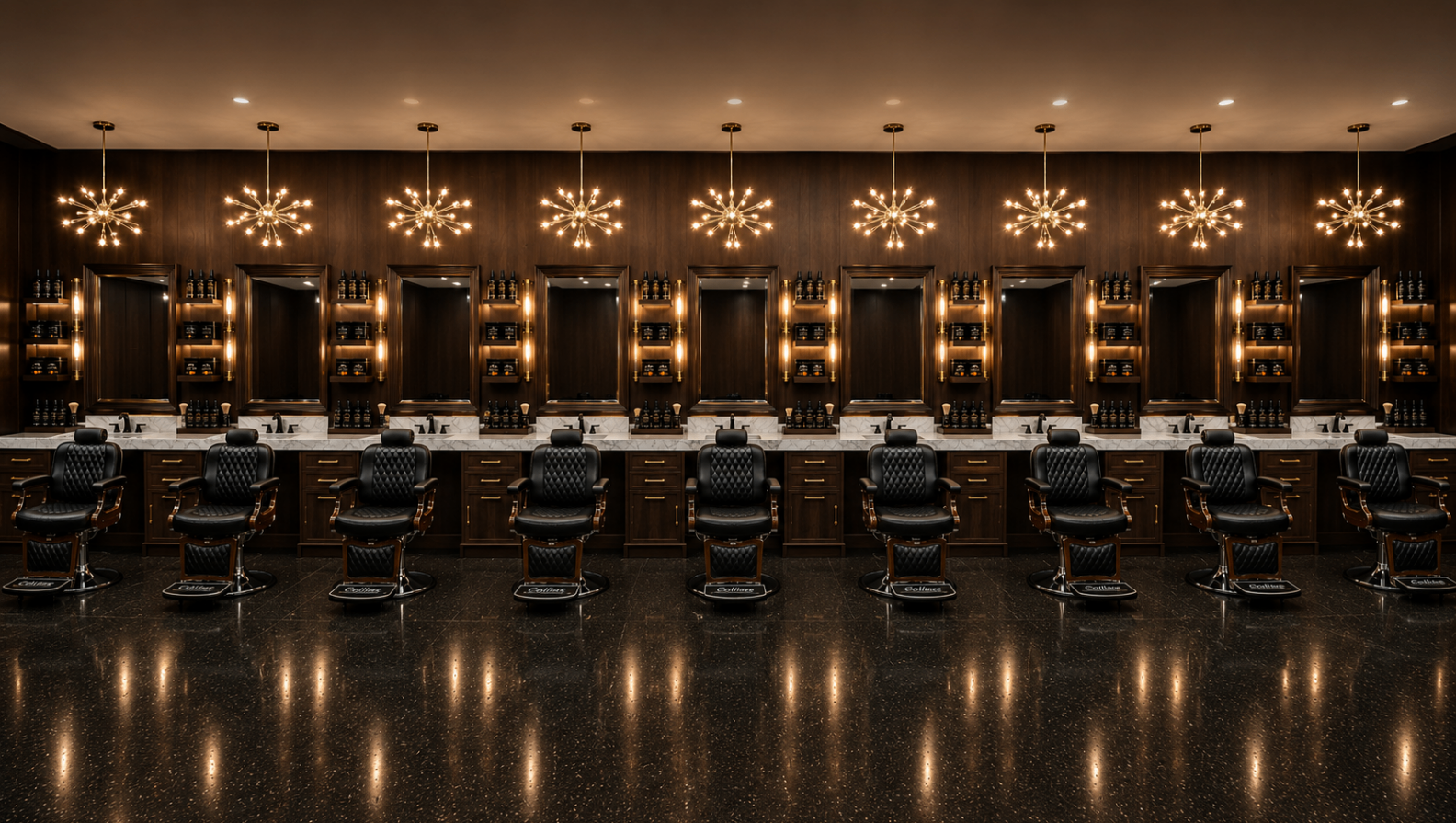
If the barbershop is going to carry that weight, it has to be built for it. Chairs you can wait in without wanting to leave. A bar that gives the room a reason to linger past the appointment. Light that flatters. Music at a volume that invites conversation rather than replacing it.
That is the whole of the LUX thesis. We are not reinventing the haircut. We are rebuilding the room around it, at the standard hospitality deserves.